Ongoing
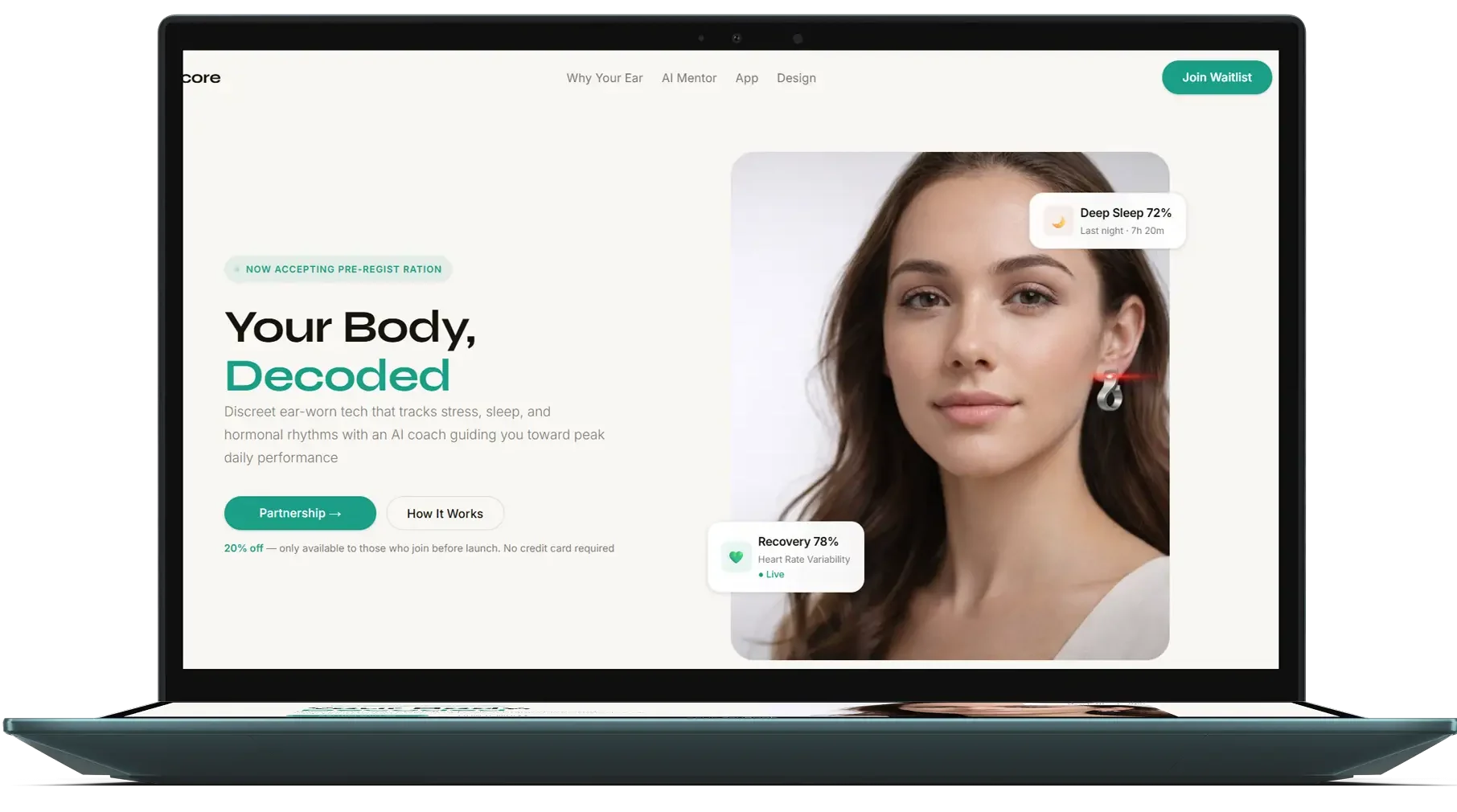
Auricore
Leading discovery research for an ear
worn health wearable
Role: User Researcher
Focus: End-to-end discovery research
Timeframe: Ongoing — currently in participant recruitment(2025 - Present)
OVERVIEW
Auricore is an early-stage health-technology startup developing an ear-worn wearable for continuous health sensing (heart rate, blood oxygen, body temperature, and movement/fall detection).
I’ve worked with Auricore for over a year, owning several areas of the product as an early stage generalist, and I’m now leading the discovery research that shapes who the product is really for and what it should measure. This is a live project. What follows is real work completed over the past year, plus current research that is still in progress.
My role — a year with Auricore
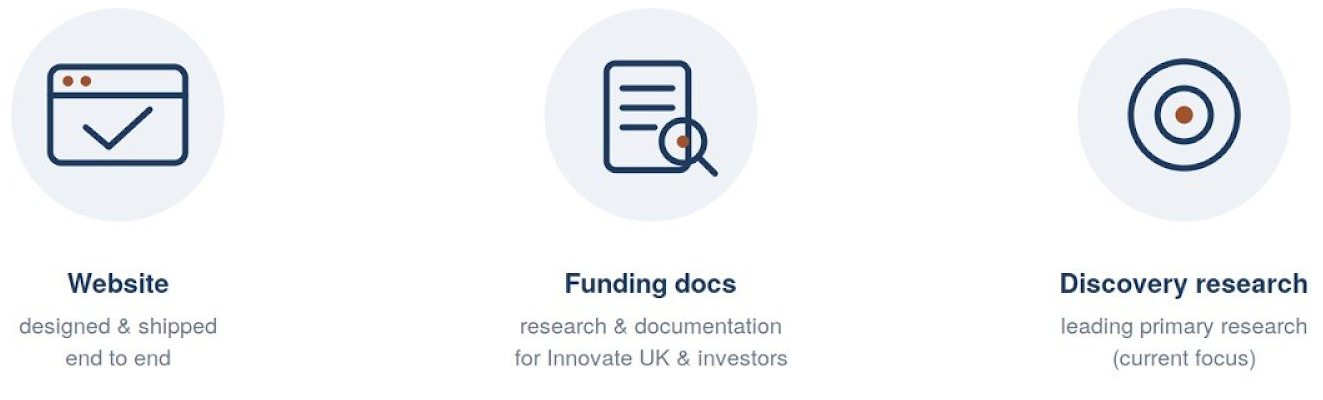
As one of the early people on an emerging startup, I’ve owned work across several areas:
Website (shipped). I owned the design and structure of Auricore’s website end to end, information architecture, content, and experience, which a developer then implemented. The site is live.
Funding documentation & research. I’ve been responsible for preparing the research and documentation behind Auricore’s funding applications, including to Innovate UK and private investors, with the founder reviewing and approving the final material. This work was built on solid secondary research, real data drawn from existing published studies and statistics.
Discovery research (current focus). The natural next step to strengthen the funding case was to move from secondary data to our own primary research, first-hand evidence about the target audience and their needs. I’m now leading that discovery phase, and it’s the deep focus of this case study.
The process
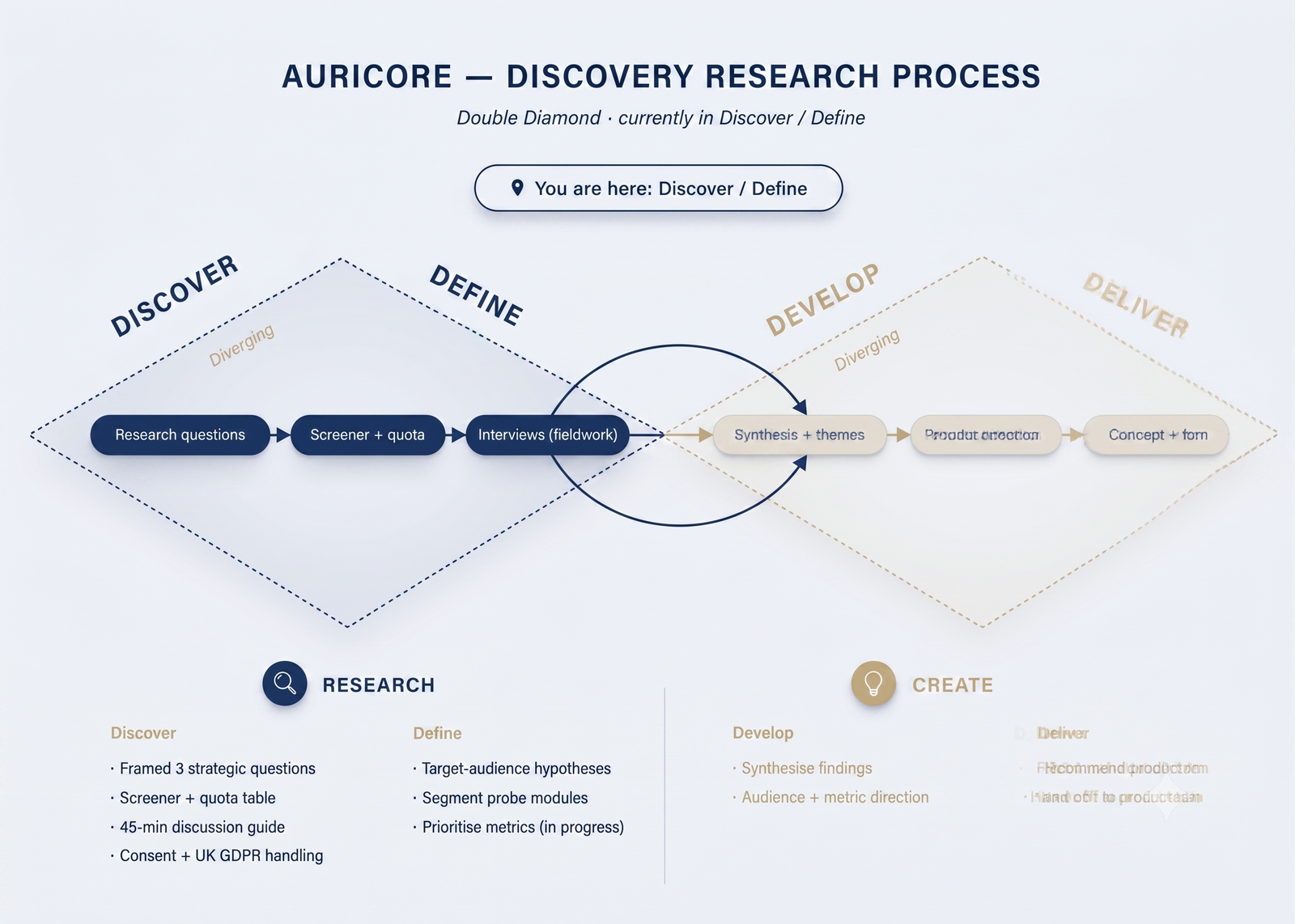
I structured the Auricore discovery around the Double Diamond framework, focusing on the first two phases, Discover and Define, where the research shapes who the product is for and what it should measure.
Rather than treating the diamonds as a fixed sequence, I used them to keep the work honest about where evidence ends and decisions begin: diverging to explore the audience and their needs, then converging on the questions and metrics that actually drive product direction. The Develop and Deliver phases will follow once fieldwork is complete.
The project is currently in Discover / Define, the diagram below reflects that, with completed work highlighted and later phases shown as planned.
The challenge
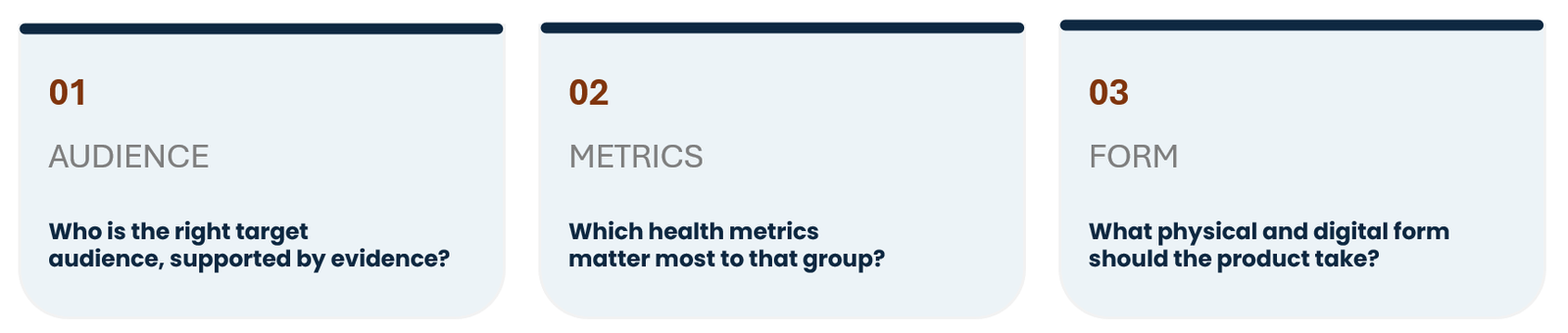
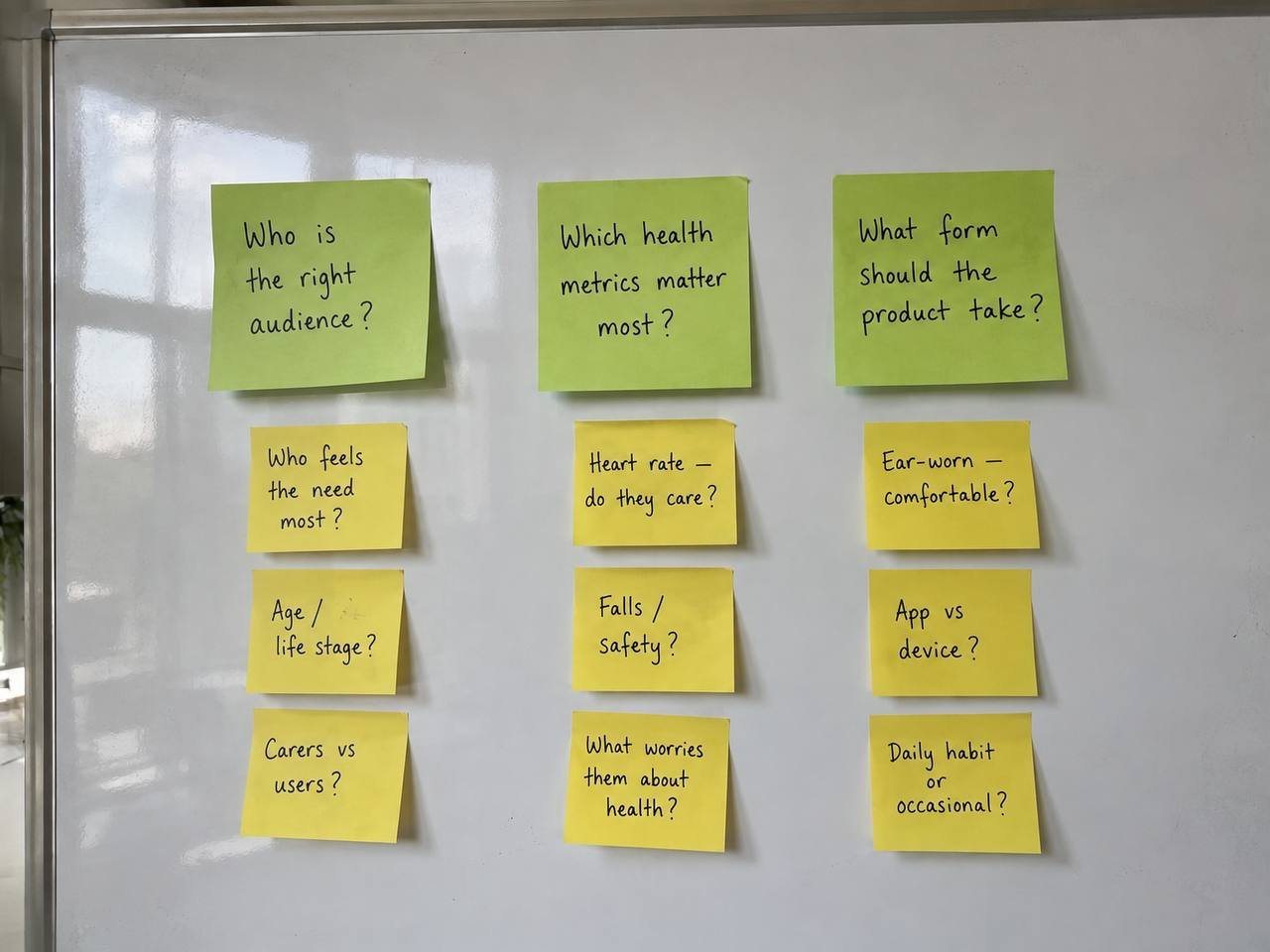
The confirmed sensors can measure several signals, but “what a device can measure” and “what a specific group of people actually needs” are two different questions. The earlier funding proposal was grounded in secondary research: real, but drawn from other people’s published data. To make the case stronger and the product direction sharper, we needed first-hand evidence of our own. So I framed three strategic research questions to anchor the discovery phase, each tied directly to a product decision:
1. Who is the right target audience, supported by evidence?
2. Which health metrics matter most to that group?
3. What physical and digital form should the product take, based on those findings?
My approach
Because this is a discovery phase with no existing user base and no research budget, I designed a study that could produce trustworthy first-hand evidence under real constraints.
Framing questions around decisions. I turned open product questions into research questions that each map to a concrete product decision, so the findings feed directly into direction, and into a stronger funding case, rather than sitting in a report.
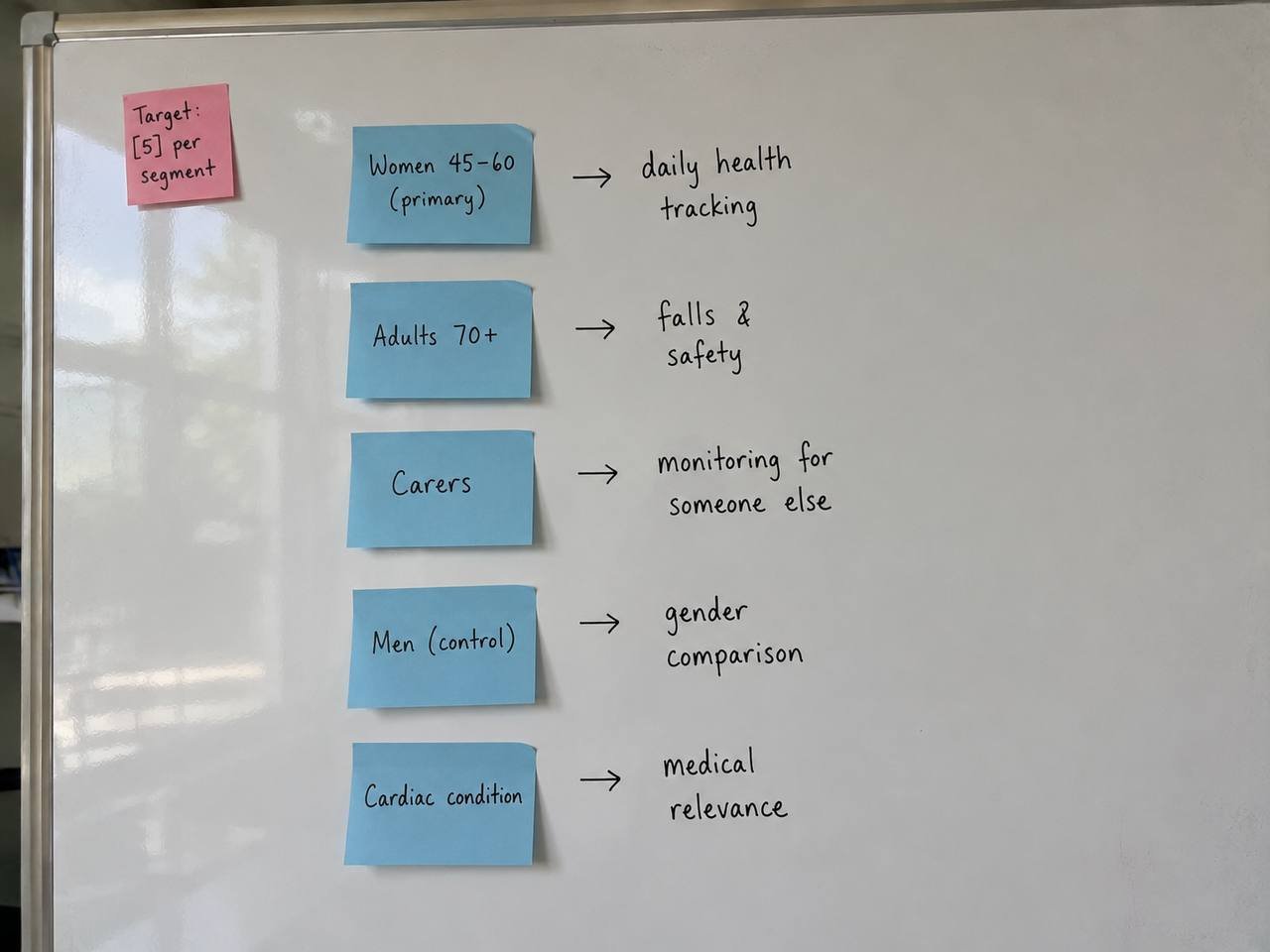
Defining who to talk to. I built a participant screener with a quota table so the sample reflects the groups the product decision depends on. The primary hypothesis centres on women aged 45–60, with secondary pathways covering adults 70+ (falls), carers, a gender control group, and people with diagnosed cardiovascular conditions.
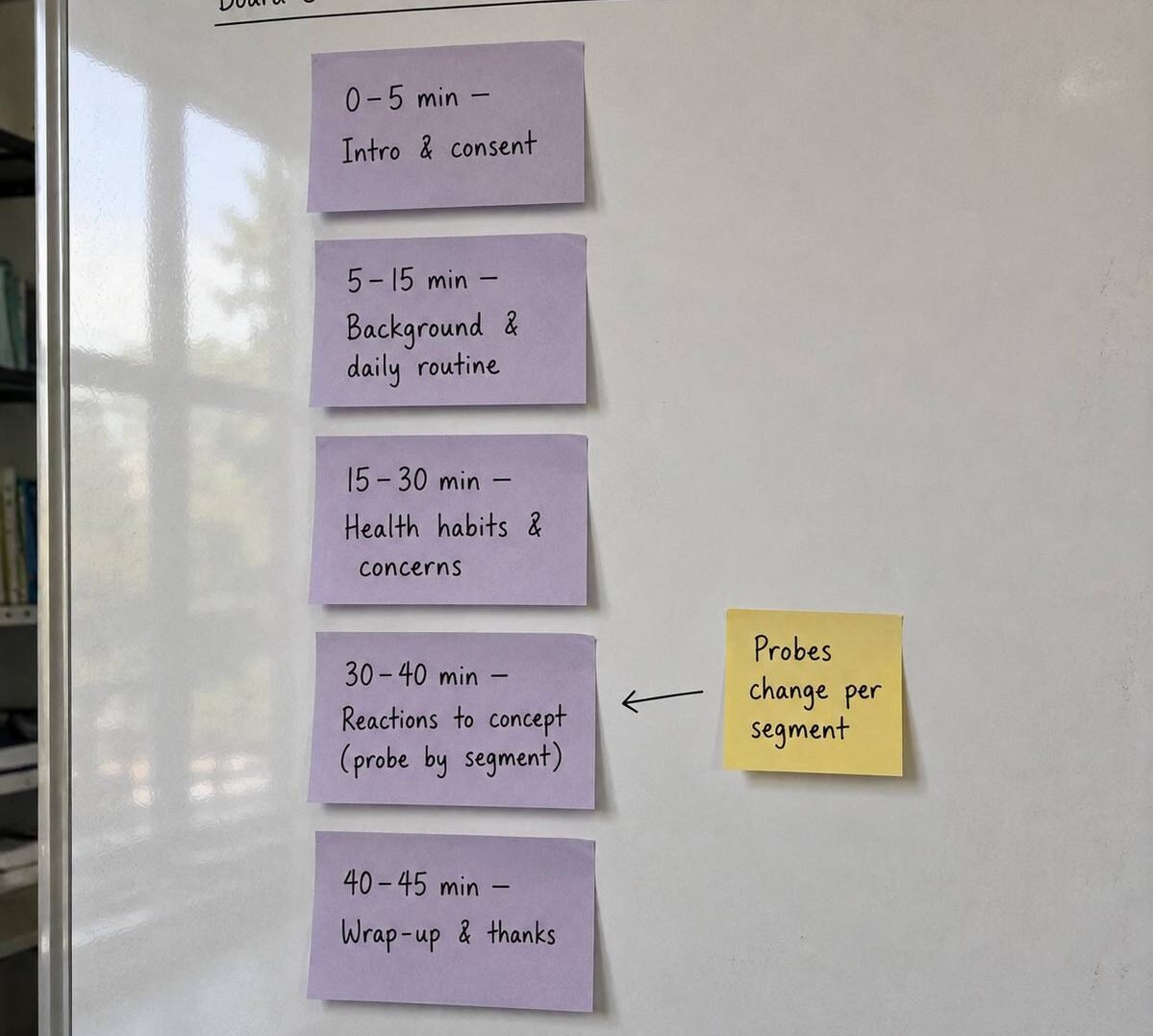
Designing the sessions. I wrote a 45-minute discussion guide with segment-specific probe modules, so each type of participant is explored against what matters most for their profile.
Handling ethics and sensitive data. The screener collects special-category (health) data, so I designed the consent process and data handling with UK GDPR in mind, including explicit, separate consent for using the work as a portfolio case study.
Removing friction from recruitment. With no budget or waitlist, I planned a zero-cost recruitment strategy through community channels U3A, Menopause Cafe, WI, libraries, parkrun, and shortened sessions to reduce the barrier to taking part.
Where the project is now
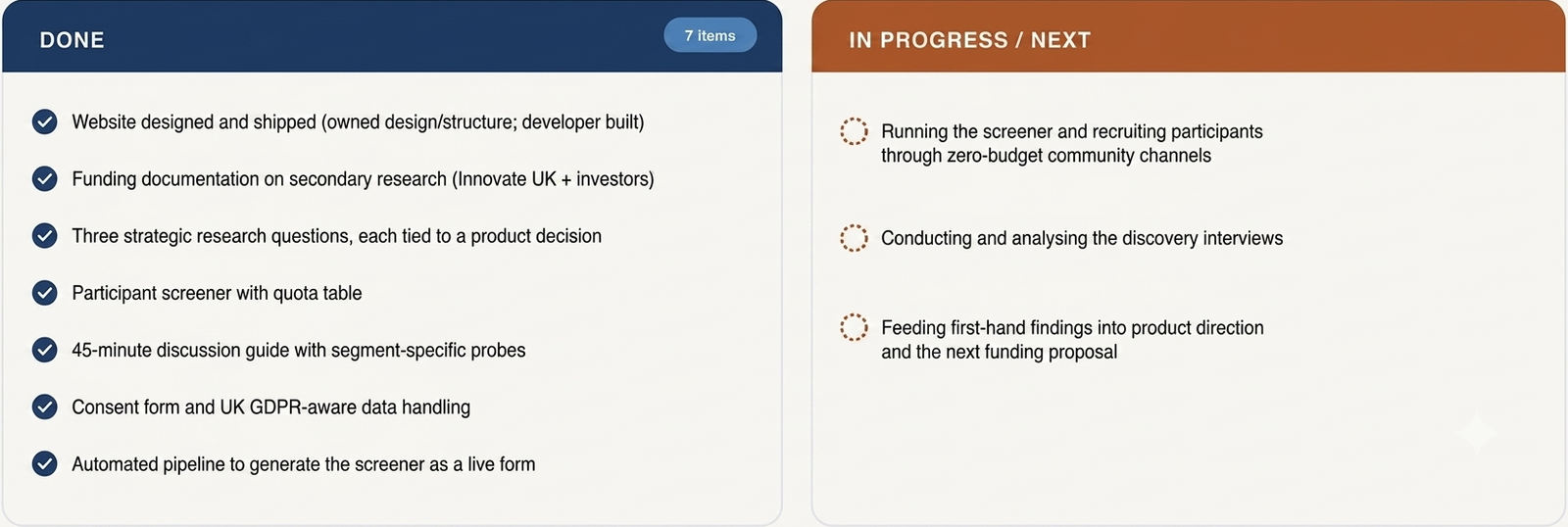
Done
- Website designed and shipped (I owned design/structure; developer implemented)
- Funding documentation prepared on secondary research (Innovate UK + investors)
- Three strategic research questions, each tied to a product decision
- Participant screener with quota table
- 45-minute discussion guide with segment-specific probes
- Consent form and UK GDPR–aware data handling
- Automated pipeline to generate the screener as a live form
In progress / next
- Running the screener and recruiting participants through zero-budget channels
- Conducting and analysing the discovery interviews
- Feeding first-hand findings into product direction and the next funding proposal
Research advocacy
Working on a health product, I’ve also paid close attention to the gap between what the confirmed sensors can support and the health claims around the product. I treat raising these questions with the team, professionally and early, as part of the research role, not separate from it.
My recent work
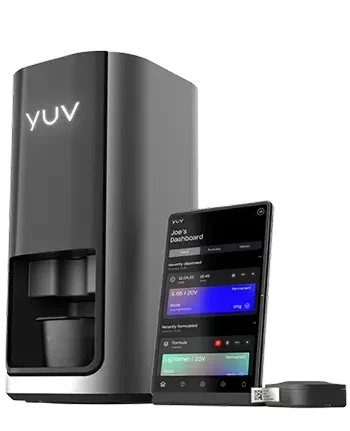
YUV
Designing the digital experience for a smart hair-colour system.
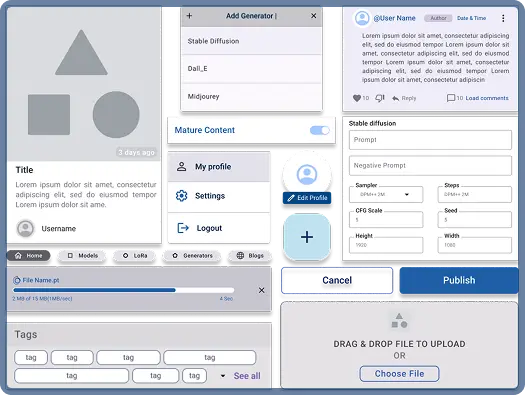
AI Art Platform
Building a scalable design system for an AI image-generation platform.
Hybrid Teams
Positioning a startup with audience research.